
Read the Faraday proposal by separating currency continuity, reward per block and issuance over time. This guide explains why a longer target block interval can accompany a larger block reward without changing the planned rate of new BNT. It uses released core v0.22.0 for the present baseline and the official October 27, 2026 announcement for the proposed transition. Faraday is still being built and tested.
Would Faraday change the currency or its planned issuance?
The official Faraday proposal keeps Blocknet’s chain, history and balances. It pairs a longer target block interval with a doubled block reward to preserve planned issuance over time. BNT remains the currency. The proposal is still under development, so use released rules for current accounting and announced parameters for clearly labeled future illustrations.
The same currency continues through the upgrade
The official Faraday announcement describes continuity of the chain and its recorded history. That matters when reading monetary claims: an upgrade of transaction rules does not itself create a second stock of coins. The announcement’s continuity statement supports reading the transition as the same BNT economy, rather than a new allocation to holders.
Currency continuity and wallet migration are separate questions. The published plan requires holders to move coins into the upgraded system after activation; the exact steps will be published before the upgrade. The Faraday upgrade guide covers that preparation and the announced migration window. Keep following those instructions even though the chain and currency continue.
For a monetary comparison, carry forward the existing history and then examine what each subsequent block adds. This avoids counting a change in transaction format as fresh issuance, or treating a migration operation as an extra reward. Here the question is how scheduled new coins enter that continuing system.
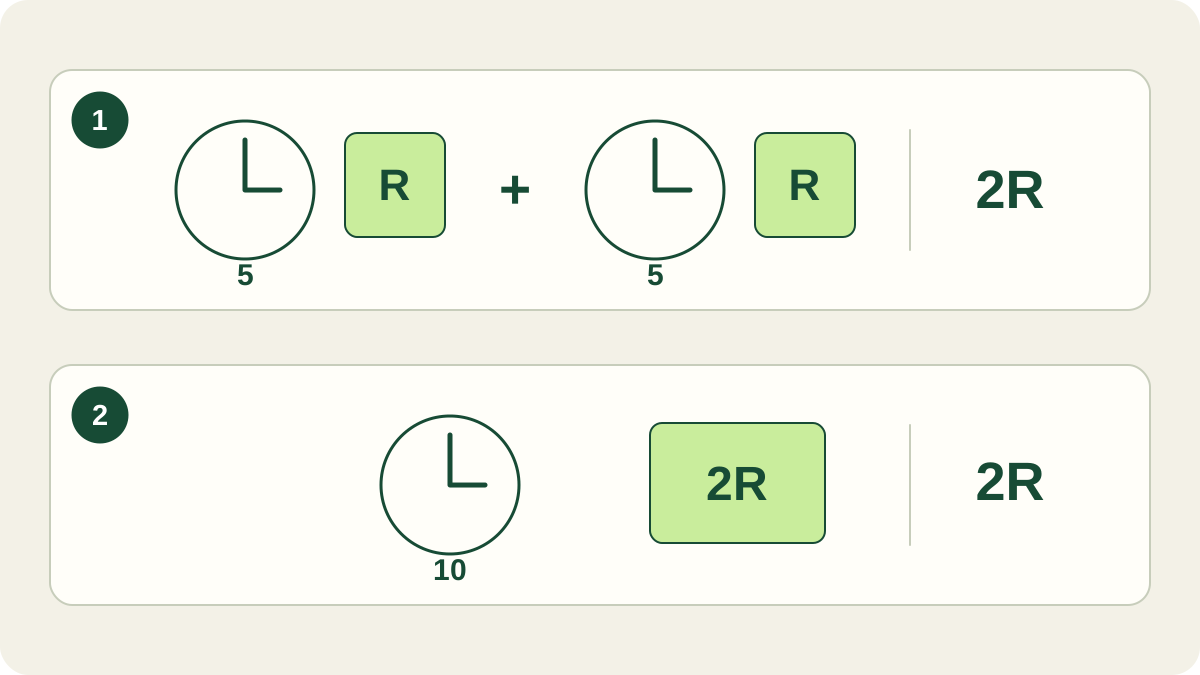
1 shows the released timing baseline and 2 the proposed pairing. The illustration compares target intervals, not a guarantee that any particular ten minutes contains those blocks. R stands for the reward at the schedule stage being compared.
Why does reward per block differ from issuance per day?
A block reward has units of BNT per block. An issuance rate over time also needs a block rate. Looking only at the first number leaves out how often it is intended to occur. This is why a headline about doubling the reward needs the interval beside it before you can infer anything about daily new supply.
The released target of five minutes gives 288 target intervals per day. A ten-minute target gives 144. Calling the comparable reward R, the relationship is 288 × R = 144 × (2 × R). This is our arithmetic explanation of the announced pairing: the decrease in target block frequency offsets the increase in reward per block.
That identity does not forecast an individual day’s exact output. Blocks do not arrive on a wall-clock appointment, and the calculation assumes the matched reward stage. For a daily measurement, use blocks actually added over the selected period and the reward applicable to each height. For a planned rate, label the target timing and reward assumptions explicitly.
How to read the announcement’s rounded figures
The announcement illustrates the fork month with approximately 343 BNT becoming approximately 685 BNT per block, alongside roughly 98,700 new BNT per day. Those are rounded descriptions of the same planned rate. Treat them as one illustration, preserving their approximate labels, rather than multiplying the displayed rounded values and presenting the result as an exact protocol total.
A live reward belongs to a particular height under a particular release. The current reward schedule explains the existing height-based stages. Its monthly table answers a current-chain question. The Faraday example answers how a proposed interval change can preserve issuance. Keeping those reference points separate makes both sets of numbers useful.
For example, the statement that a reward doubles says how two corresponding stages relate. It does not supply a finalized table for all future heights. The Blocknet supply guide explains the released tail and the approximate initial distribution target. Read those current values with their release label; the announcement does not publish every final future tail parameter.
Distinguish new issuance from moving existing funds
Transaction processing and the issuance schedule describe different parts of monetary accounting. A normal payment uses existing funds to create recipient and change outputs. Its fee is paid from those existing funds. Neither the act of sending nor the presence of a fee creates additional BNT. The transaction walkthrough explains that value flow.
Likewise, a pool distributes funds to miners after accounting for their work and the relevant payout conditions. Receiving that transfer does not mint the block reward again. Maturity determines when newly created funds can be spent, while a payout determines where existing funds go. The pool payout guide covers distribution; monetary issuance is counted when the block reward is created.
Keep current rules and future assumptions clearly labeled
The official target is February 2027 at block 103,680, with timing dependent on testing. Treat that as a plan rather than a guaranteed calendar appointment. The announcement explicitly leaves room for changes to numbers, dates and design before activation. Check its latest text when using proposed parameters in a calculation or explanation.
A useful comparison records the source date, the applicable rule set, the target interval and the reward stage. It then states whether the result is observed issuance or target-based arithmetic. This keeps a statement about a larger block reward from silently becoming a claim about a larger daily supply increase.
For now, use released rules to interpret current blocks and follow the upgrade guide for preparation. When the final release and activation details arrive, compare them against the same questions: what currency continues, how much each block issues and how frequently blocks are targeted. The seine mining guide covers participation in today’s network with bntpool.com.
Frequently asked questions
Does Faraday create a new token or an airdrop?
The official announcement describes an upgrade of Blocknet that preserves the chain, its history and balances. It does not describe a new currency allocation or an airdrop. Wallet migration is a separate part of the transition, with steps to be published before activation; continuity of the currency does not replace those migration requirements.
Why would a doubled block reward leave daily issuance unchanged?
The proposal doubles the target interval from five to ten minutes as it doubles the reward per block. That means half as many target intervals per day, each carrying twice the reward. Multiplying reward by target blocks gives the same planned issuance rate. Actual daily block counts still vary.
Can I use the proposed Faraday reward as today’s live reward?
No. The announcement describes an upgrade still being built and tested, and its figures can change. Use the currently released schedule and the relevant chain height for current rewards. The rounded figures in the Faraday post illustrate the proposed fork month; they are not a live reward quote or final parameters for every later stage.