
Fungibility is one reason privacy matters when a cryptocurrency is used as money. You want to settle an agreed amount in BNT without treating each unit as a different product because of its earlier payment history. This guide explains the currency concept, how Blocknet’s ordinary payment format supports it, and how it differs from acceptance, exchange price and spendable balance.
What is fungibility in Blocknet?
Fungibility means that equal amounts of a currency can serve interchangeably in payment. Blocknet’s privacy mechanisms support this property by reducing the public payment-history information attached to ordinary transfers. They protect how money moves, while recipients still choose whether to accept BNT and wallets still apply the normal rules for spending funds.
Why should equal currency units be interchangeable?
Consider an illustrative purchase priced at 5 BNT. The currency amount tells the parties what is owed. In the idea of fungible money, two available holdings of 5 BNT can each satisfy that amount; the buyer does not need to price every unit as a collectible with a distinct biography. The example explains the concept, not an actual shop or a promise that a seller accepts BNT.
Dividing and combining value does not change that purpose. One available amount or several smaller amounts can fund a payment, provided the wallet can build a valid transaction and cover its fee. The transaction walkthrough explains how inputs become recipient outputs and change. Outputs are technical containers of value. Their number does not define a separate currency denomination or say how many people were involved.
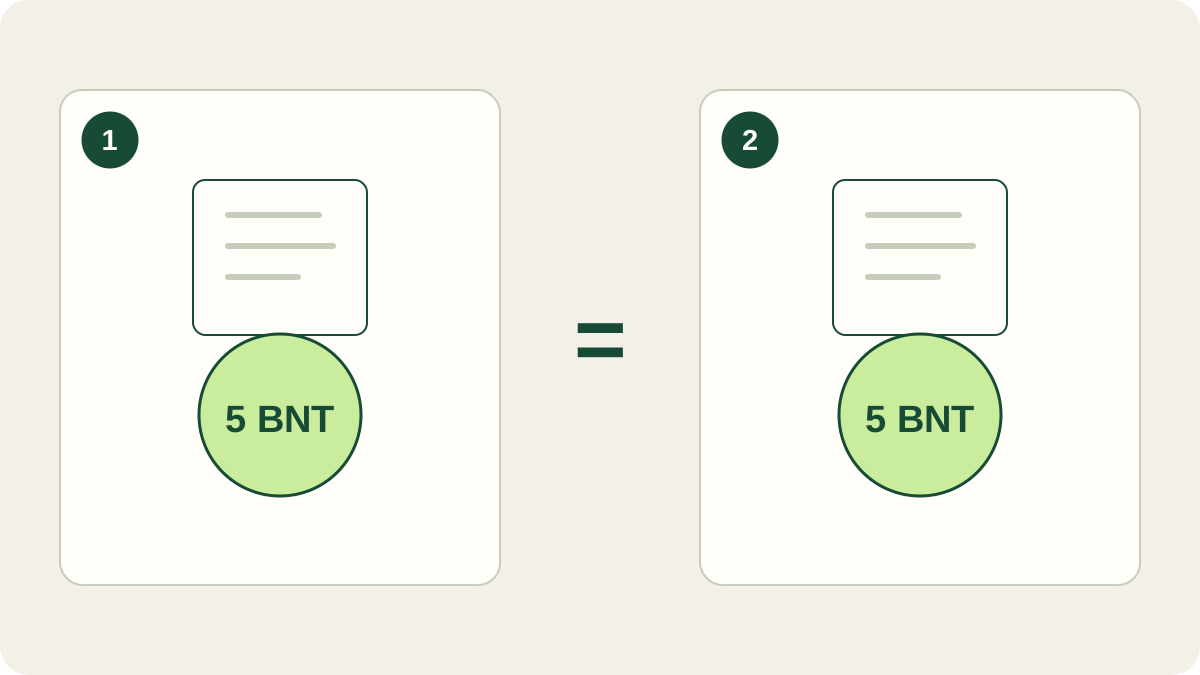
The two receipts illustrate equal quantities of BNT. The comparison concerns their currency value; a real payment also follows the wallet’s fee and spendability rules.
How does transaction privacy support fungibility?
Public payment histories can supply reasons for people to distinguish between units that have the same face amount. Privacy reduces the information available for that sorting. In Blocknet’s released ordinary payment format, a ring signature places the spent output among possible sources, a one-time output key protects the receiving destination, and commitments keep output amounts out of the ordinary public record. These mechanisms support using BNT for its currency value rather than publishing a readable chain of personal purchases.
Today each normal input uses 16 ring members: one real output and 15 decoys. The decoys do not add their owners’ money to the payment. Nodes verify authorization and amount balance, and key images support detection of repeated spending. The privacy-by-default guide explains the layers. Privacy and valid accounting work together; hidden payment details do not remove the network’s transaction checks.
Applying those mechanisms in the ordinary payment path matters too. Users do not need to enable a separate protected mode for a particular purchase. The same basic format serves routine payments, rather than making privacy an exceptional transaction choice. That consistency supports the currency goal. It does not establish that every transaction has identical size, identical structure or identical outside context.
What does the person receiving money still know?
The recipient’s wallet identifies its own incoming outputs and recovers their amounts. The sender knows the destination and amount they entered. Those are useful records for checking whether an agreed bill was paid. In an illustrative sale, the seller might also hold an order number and delivery details. The private transaction format does not erase records the buyer and seller exchanged.
Public transaction data still includes a hash, input and output structure, and the fee. A person deliberately given a payment proof or wallet viewing access can learn more. The payment-visibility guide explains those access differences. Fungibility is a reason to value payment privacy; it is not a claim that nobody can learn anything about a payment.
The practical currency question is what must accompany the transfer. A payer can provide the agreed payment and whatever receipt evidence the parties choose to exchange. They do not automatically publish their full wallet accounting as part of an ordinary payment. Keep that benefit separate from any claim about what a particular business records or requires.
How is fungibility different from price, supply and spendability?
Acceptance is a decision by the person or service receiving money. Exchange price describes what someone offers for BNT in another currency or asset. Neither follows automatically from transaction privacy. Two equal BNT amounts represent the same quantity of BNT even while an exchange rate changes; fungibility does not promise a stable purchasing power or a return.
Blocknet’s supply is another question: it concerns issuance and how the total develops over time. Wallet availability concerns which outputs can be spent now. New receipts and change can wait for confirmation or maturity, while older eligible outputs remain available. The transfer-time guide explains that process. Waiting for an output to become spendable does not create a new kind of currency, just as splitting a payment across several outputs does not create several kinds of BNT.
How should you read current and proposed privacy rules?
This discussion uses released core v0.22.0 for current payment mechanisms. Ordinary spends and the special transaction creating a block reward have different validation paths; the ring description applies to normal inputs. Compare currency denomination separately from wallet state and transaction type.
The official Faraday proposal describes a future change in the spending proof and receiving mechanism. Faraday would use proofs over the full set of Faraday coins, with that set growing as coins enter the new format. It remains a proposal, rather than a description of today’s active payment rules. Read the Faraday privacy guide for the mechanism and the monetary-policy guide for the separate proposed issuance and timing questions.
When making a payment, agree on the amount, verify the intended recipient and use the wallet’s current spendable funds. The sending guide covers that workflow. Fungibility explains why equal currency amounts should work interchangeably; Blocknet’s privacy layers support that use while the parties retain their own payment records.
Frequently asked questions
What does fungibility mean for Blocknet?
Fungibility means equal amounts of the same currency can serve the same monetary role without each unit needing a separate value based on its past owners. For Blocknet, payment privacy supports that goal by reducing publicly available payment-history details. It does not determine the exchange price or require any person or business to accept BNT.
Does a private payment mean the recipient knows nothing?
The recipient’s wallet recognizes its own incoming outputs and their amounts. A recipient may also know the payer through an invoice or conversation. Privacy protects information in the ordinary public transaction record; it does not erase the participants’ records. A payment proof, screenshot or shared viewing access can reveal additional details deliberately.
Are fungibility, available balance and supply the same thing?
They answer different questions. Fungibility concerns whether equal currency units serve interchangeably. Available balance concerns which wallet outputs can be spent now under confirmation and maturity rules. Supply concerns how much currency exists and how issuance changes over time. A newly received output can wait to become spendable without becoming a separate kind of BNT.